Pages

Sunday, May 30, 2010

Cleansing Our Pallets, Part II

The internet will back me up on this: there are endless uses for the ubiquitous pallet. And, in this case, necessity is the mother of invention. My necessity was to get rid of extra pieces of pallets that wouldn't work for building flats. Believe it or not, all those "waste" stringers I mentioned in Part I were the perfect material for something else I didn't even think about needing: tables to put the flats on! Construction was very simple. Each table requires 11 stringers, which you can get from three or four pallets (depending on their design). I started by removing the extra wood and nails from them. This step isn't absolutely necessary for the legs and top surface, but it looks much nicer and you won't have nails grabbing you as you walk by.
I had removed the boards for flat material by cutting right along each stringer with a circular saw. That left the stringers you see in the photo here, complete with pieces of board still nailed in. I found I could break these off of the nails easily with sideways hammer blows. I was left with nails that could not be pulled out. Most would allow themselves to be hammered in, some were bent and hammered flat.

All of the stringers were 48" long, so I let that dictate the length and width of the table. Two stringers would form the crosspieces, making the table 48" long, and five stringers would be cut in half to make ten surface pieces for a 24" wide table. The legs were cut to 37" to create a reasonable height. I chose the six straightest, flattest, and strongest stringers for the legs and cross-pieces.

I assembled the surface first, laying the 24" surface pieces flat on the cross pieces and nailing them. The gap between each was something like 1½". Then I upended the surface and attached the legs with screws. I spent some time making sure they were square before affixing them, but it turned out not to make a clear difference. They were a little wonky anyway.

When I righted the whole thing it was obvious that it was not so stable, so I added the diagonals you see in the photos. They were scrap flat material.

I needn't state that beauty is in the eye of the beholder, and that function often comes before aesthetics for me. If I find that Warren Buffet writes me into his will I may commission an Amish cabinet maker to fashion me some nice mahogany flat tables. Until that point, though, I will be very pleased with these. They are sturdy enough to jump up and down on (our seedlings do a lot of that), durable enough to last at least a few seasons, and were free wood.

Thursday, May 27, 2010

You Think YOU Have Problems?

Just imagine how this guy felt.
When Margo was walking through the dog room this morning she noticed that we had a guest. "Hey Dan! Come here. There's a chipmunk stuck in the window." I'm not sure what I heard her say, but it wasn't that, because I stayed at the table eating my oatmeal. At her insistence I came to look, and was surprised. And, of course, went to get the camera.
Some folks use video to make an educational impact. I can already tell that, on this blog at least, it is going to be reserved for entertainment. Here's the main idea: this chipmunk is in between the window and the window screen. How did it get there? Who knows.

We just know how we wanted to get it out.

It would have been pretty easy to remove the screen and let it jump the five or so feet to the ground, but then it would have had to face three dogs who were anxious to make its acquaintance. So we got it out the other way, and got another priceless photo.
I think the whole operation will go smoother the next time this happens. If only we had gotten to practice first on a sloth...

Baby spinach, anyone? It's organic!

Monday, May 10, 2010

Kamütlichkeit

That would be the state of contentment with one's ancient wheat. We finished our spring grain planting a week or two ago, spotted any damaged or disappeared plants last week, and can now settle in for the joy of watching it tiller and grow. While we're doing everything else, that is. You can find the varieties we planted below in The First Transplant. Next year we will put in some less common varieties of barley and spring wheat that we ordered from Bountiful Gardens to see how they do in our climate.
But back to our featured star. Kamut, like an ancient anything, is kind of a funny bird. Its past, previous to its appearance in the US in 1949, is foggy. A concise assessment of the story can be found here. And a briefer one follows: A US Airman stationed in Portugal was approached by a man who offered him 36 grains of this wheat, telling him it was found in a pyramid tomb in Egypt. He mailed them home to his grain-growing Dad, who grew them to great satisfaction.
It makes for an entertaining story, which could be embellished (but not verified) to a great extent. Without knowing more it could be taken as a complete hoax. But Kamut, compared to modern improved wheat, has a much larger kernal, and despite its 30% higher protein content it doesn't illicit a reaction from many who have wheat allergies. Adding that its DNA is different enough from modern varieties that geneticists have had a hard time figuring out its definite origins, you have a compelling case that it has remained out of breeding circulation for a long time.
(Here are images comparing Kamut with a variety of hard red winter wheat. I would have taken them myself, but, um, we planted all of ours. These are from thenibble.com and homestylemercantile.com, respectively.)
And don't bother looking it up on wikipedia. As of this posting the entry for Kamut looks like it was written by the company that holds its patent. What? It's patented? Yes, I was skeptical too, but I can see where they are coming from. They got the patent in 1990, which made it one of the only 5 non-genetically engineered patented plants (there were already 65 patented GE plants by then). The company gives their explanation on the "Why a Trademark?" portion of their site. And, I have to say, it seems like an ok idea. Especially because Kamut is already in wide circulation, its growing is not in any way prohibited, and the trademark seems to be applied only to the marketing of it. As opposed to Monsanto, who might sue you into bankruptcy for unknowingly having one of their patented seeds in your field. Instead, it seems that Kamut International is trying to maintain the purity of seed claiming to be Kamut. Which is fine by me.

We were aided in our planting by my sister Anne, who was visiting for a few days. As you can see, we were all working together on a strict timeline. That's me, behind, double-digging the bed just before they move their digging board back. Not standard operating procedure. But good, wholesome, community agriculture fun all the same!

Friday, April 30, 2010

You Read to Me, I'll Read to You (Part II)

Here's a running list of books we've read. We'll endeavor to keep it updated in order, but initially it will be what we remember having read. The ones we've found to be exceptional in some way get an asterisk. Ones we didn't finish get a minus.

Living More with Less: the 30th Anniversary Edition by Doris Janzen Longacre finished 2/10/12 -- An inspiration and record of ideas toward simple living. I wish they had a version that didn't so highly praise the original book. This one can stand on its own merits without constantly citing the reputation of the first edition.
Unbowed, by Wangari Maathai finished 11/23/11 -- As the narrative evolved past the first chapter it became more and more incredible to think she managed to get anything accomplished. And if it had been biography instead of autobiography I would have wondered at what point she would be "disappeared". Peris substantiated this sense by commenting that she was the only one who stood up to President Moi, and everyone expected she would be killed. Read this book to see what is possible in impossible circumstances. We learned the sad news two days after dropping Peris and Mary off at the airport, that on that Sunday, September 25th, she passed on.
Jane Eyre, by Charlotte Brontë finished 3/15/11 -- Like The Sixth Sense, it has a plot twist plot twist that everyone who's read it will give away inadvertently when you tell them you are reading it. But we enjoyed it anyway.
The Hunchback of Notre Dame, by Victor Hugo finished 11/20/10 -- Dan was disgusted with it. Especially all of the really boring parts, which he would have skipped but Margo said were "part of the experience". It is, however, great writing, and he strings you along to the very end, just like Melville's Moby Dick.
*Shogun, by James Clavell
Tai Pan, by James Clavell
Middlemarch, by George Eliot (actually Mary Anne Evans)
Pride and Prejudice, by Jane Austen
Sense and Sensibility, by Jane Austen
The Continuum Concept, by Jean Liedloff
*Autobiography of a Yogi, by Paramahansa Yogananda
Moby Dick, by Herman Melville
- Look Homeward, Angel, by Thomas Wolfe -- Margo loved it, Dan didn't.
- Mists of Avalon, by Marion Zimmer Bradley -- Dan loved it, Margo didn't.
Lord of the Rings, by J.R.R. Tolkein
The Hobbit, by J.R.R. Tolkein
Harry Potter, 1-3, by J.K. Rowling
- Harry Potter, 4-7, by J.K. Rowling -- Margo didn't read these.
Chronicles of Narnia, by C.S. Lewis
The Old Man and the Sea, by Ernest Hemingway
The Three Musketeers, by Alexandre Dumas
Anna Karenina, by Leo Tolstoy
Hitchhiker's Guide to the Galaxy, by Douglas Adams
Don Juan, by Lord Byron
Saving Fish from Drowning, by Amy Tan
The Kitchen God's Wife, by Amy Tan
The Joy Luck Club, by Amy Tan
Le Père Goriot, by Honoré de Balzac
Dune, by Frank Herbert
Dragons in the Water, by Madeleine L'Engle
An Acceptable Time, by Madeleine L'Engle
Many Waters, by Madeleine L'Engle
Arm of the Starfish, by Madeleine L'Engle
A Swiftly Tilting Planet, by Madeleine L'Engle
A Wind in the Door, by Madeleine L'Engle
A Wrinkle in Time, by Madeleine L'Engle
The Odyssey, by Homer
The Golden Compass Trilogy, by Philip Pullman
The Mary Russell books, by Laurie R. King
The Complete Sherlock Holmes, by Sir Arthur Conan Doyle
Seabiscuit, by Laura Hillenbrand
Mister God, This is Anna, by Flynn (actually Sydney Hopkins)
Artemis Fowl; The Lost Colony, by Eoin Colfer
The Call to Shakabaz, by Amy Wachspress
Kidnapped! , by Robert Louis Stevenson
Treasure Island, by Robert Louis Stevenson
The Black Arrow, by Robert Louis Stevenson
The Jungle Book, by Rudyard Kipling

You Read to Me, I'll Read to You

One of our favorite activities together, right up there with game playing, is reading to one another. It started with Harry Potter (before the series got a little too dark for Margo's enjoyment), moved on to other series books one or the other of us knew well, and grew to Lord of the Rings proportions by the time we got married. In the past four years we have begun targeting masterpieces. Ones we have never read (or read and forgot) but that we have heard of many times, and maybe feared. Like Moby Dick, which we found very entertaining. Or Don Juan, the epic poem by Lord Byron, which took a little time in getting the flow right, but which was also very enjoyable. Sometimes it's a book that one of us has read and wants to introduce to the other, like Dune or Hitchhiker's Guide to the Galaxy. Very infrequently we will give up in the middle of one due to one party or the other's objections. Like Mists of Avalon and Look Homeward, Angel.
You might wonder where we get so much time to read. Somehow it justs fits into spaces. Like when I am driving or doing dishes, or when Margo is cooking or knitting. And if the book is very good, we make time.
All this is to introduce our current reading, which I would like to keep updated as we go along with a reference from the sidebar. Once this post is buried under the many to come, that is.
Last month we finished Tai-Pan, by James Clavell. We read it because we liked Shogun so much. It was entertaining, even riveting at points, but not the grand read that Shogun is.
We just finished Saving Fish from Drowning, by Amy Tan. Having read a few others by her we both feel like this one is alright, is entertaining, but has not made us better people or expanded our horizons. This might sound a little foolish, but the latter two are the main characteristics of what we call a great book.
We just started The Continuum Concept, which was a baby shower gift from our friend Dawn. It has the mark of a book that will help us significantly in perspective for child-raising, and will alter the way we look at the world. Needless to say, we are very much enjoying it. Its one peculiarity is that the style is a bit text-booky, in terms of big words and long sentences. This means that I have to be the one to read, because I focus better that way.
And we have a list of all-time greats, which will hopefully grow. It is in no particular order.
Shogun, by James Clavell, was fascinating, enlightening, and held our attention for months. It really helped me understand the samurai origins of Aikido, and what bushido means. It gave us both a better understanding of life and death, and what honor is. In a way. One of the best stories I have ever read.
Autobiography of a Yogi, by Paramahansa Yogananda. I can't say much about it without making it sound lame. It is about saints and enlightened masters, how you get to be that way, and stresses that the capacity for love is the most powerful tool one can have. Besides that, and that it is at the top of our list, there isn't much more I can say to recommend it.
Our advice, if you want to find the best books in the library, is to talk to your librarian. We had great conversations with ours at the Willits Public Library almost every time we were there. One of the highlights was when we asked the head librarian, "Donna, we want to read some Hemingway. Which one would you start with?" Her answer was "None of them! I can't stand Hemingway!" She explained that her focus was the romantics, like Thomas Wolfe. Minimalists just weren't her cup of tea. But she did go on to consult the summer reading program's lists, and came up with The Old Man and the Sea. Which we liked just fine.

Monday, April 26, 2010

A Shout Out to Our Peeps

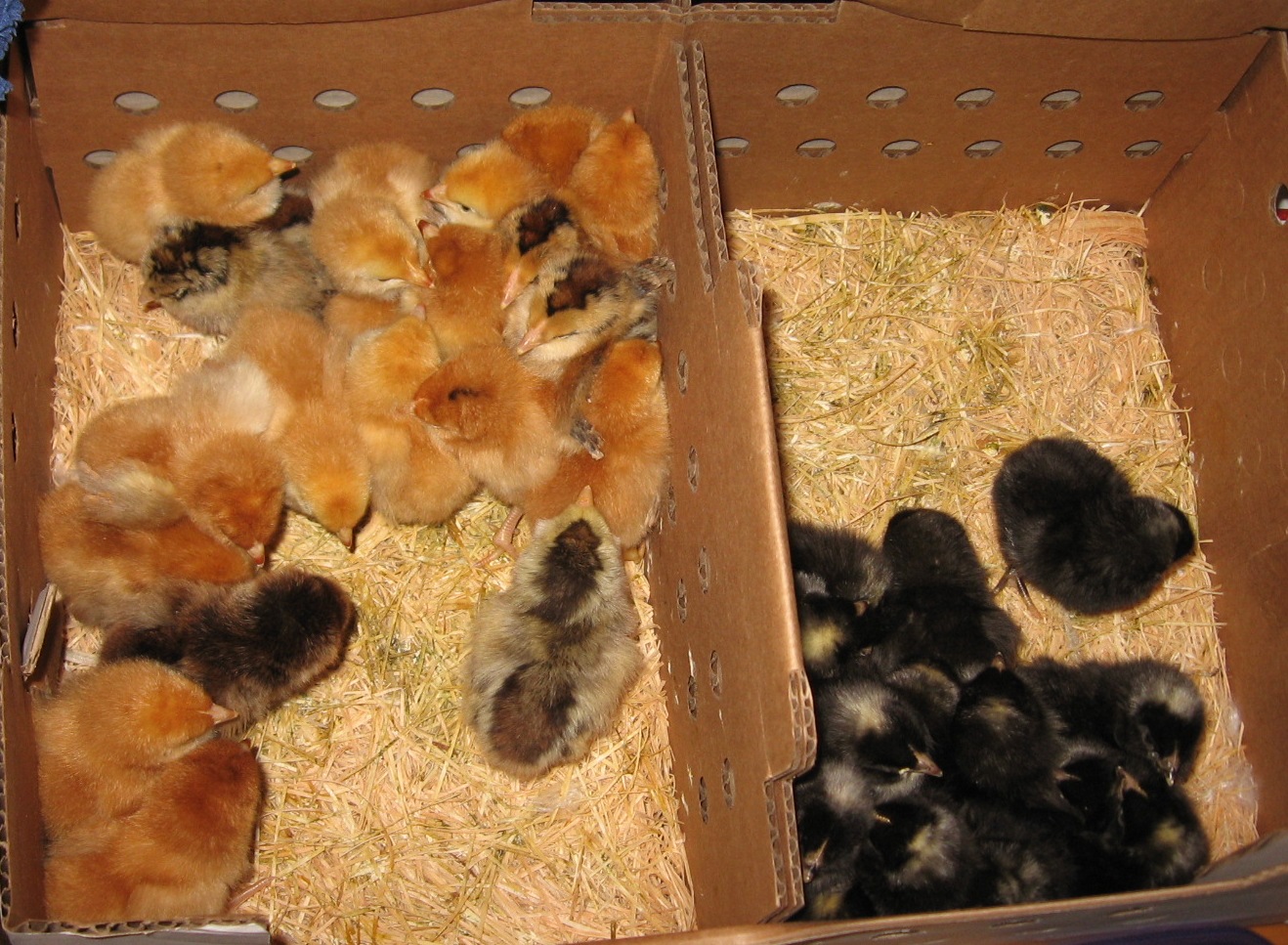
What started out as a rainy day somewhat devoid of promise has ended up a special treat: our chicks arrived! Ok, I should be more specific. They're technically Mom's chicks, but like a new puppy we can all pretend ownership when such intense cuteness is involved.
Mom participates in what I would call an Egg Cartel. Together with a number of other folks in the area who keep small numbers of chickens, she gathers eggs, pools the dozens, and delivers them to folks all over the western Dayton area. For those trying to muscle in? I'm pretty sure there are some midnight visits from The Flock. Chickens seem dumb, but they can be senselessly brutal, let me tell you. Anyone who has seen a frog or mouse get into the hen-house knows I'm not joking. And anyone who has been around chickens much knows they are certainly senseless.
But I'm straying. The point is that Mom keeps a flock of about 40-50 hens around at any one time. After about 3 years they stop laying and end up in the pressure cooker getting canned. After being killed, of course. So every year she gets another batch of chicks.
This year we have New Hampshire Reds, Black Sex-Links, Barred Rocks, and Ameraucana chicks. (If you visit those links and click on the big photo it shows two or three more great pictures, one of them the chick.) Incidentally, we ordered ours from Mt. Healthy Hatchery, in nearby Mt. Healthy, Ohio.
We showed up at the local grain elevator, which receives the orders, and made a fuss. How can you not? Baby chicks are so cute. I'll not pretend we didn't make fools of ourselves. We took them home to the pen that Mom so expertly set up: a foot-tall cardboard barrier, newspaper floor, two one-quart waterers and a food trough, plus three heat lamps. A few rocks, too, to make it interesting. And we put them in, one by one, and introduced them to the water. As Mom pointed out, the huge 5,000 chicken operations must somehow get by without doing this, but it's tradition. Each one must be set in front of the water and have its beak dipped in at least twice. So they know it's water, right? Never mind that they spend all their time running around pecking things, from food to spiders to chicken poop to their own feet. They would probably discover the water. But we don't leave it to chance: it gives us an excuse to handle each and every one of them!
At this point I am going to try a first in my blogging experience, and stick in a video. I read a book recently that asserted that chickens are much more entertaining than tv. Absolutely, I say. But what about chickens on tv?

Thursday, April 22, 2010

The First Transplant

As you can imagine, we have been reveling in firsts this Spring. Of course we have the first tick seen, first tick embedded, first chicken trying to eat our seedlings, first dog trampling our newly dug bed, and first blister. But there is the positive, too! First bed marked out and dug, first flatting, first visitors, and first purchase of exciting new tool.

And, certainly, our first transplanting. It has been intriguing to hear folks around here, when we would talk of our late start, say "Oh, yeah, well we don't usually get our garden in until around the end of April or later." In our experience, the garden is always "in". It may not seem as "in" when most everything is dead and the ground is frozen, so our feelings may change on that note. But the fact remains that it is always a garden, and we would have been working in it a month before now had we been here since February instead of off gallivanting on both coasts.
Back to the point: we have been itching to be in the garden, and we figured our most crucially timed crop would be spring grains. In pursuit of that end we flatted them first, along with our solanaceae. I dug while Margo got a start, then we both tucked in to get them done. We are now the proud guardians of 225 sq ft of spring grains: Pika, Musky, and Bamboo Curtain triticale, Schrene barley, and Hard Red Spring wheat. Soon our Kamut wheat will be up (assuming the mice don't get it - flat covers were not the priority they should have been) and heading into the soil.

We broadcast our grains into a flat, wait until they are up and around 2-3 inches tall, then transplant them on 5" centers - all 5 inches apart from their 6 neighbors. 225 sq ft of that is a big job early in the season, so we started at both ends and worked to the middle. That's what we're doing in this picture, Margo 8 months pregnant and baby wiggling all the way!

One of our big challenges right now is water. There is no electricity on site. There is open water a five minute walk away, but we would like something more accessible. Hmm... all of a sudden I feel like a real weenie.

Closer yet, there is an equipment shed with a vast roof and gutters with downspouts, and that is where I have fixed my eyes. We are really excited about a rainwater catchment workshop our local county soil and water conservation district is sponsoring, and we'll come out of that with some barrels and a clue. After that I'd love to figure out some kind of gravity-fed thing...

Today comes another first - potato planting! We got our stock this year from down the road, a huge local nursery operation. While we were tempted to order the organic ones in all manner of variety from Ronniger's in Colorado, we decided that postage would kick our butt. We'll save our own seed for next year.
Here's to months of dirty hands!