Pages

Thursday, April 14, 2011

Beautiful, but Deadly

Ok, maybe just dead-smelling. The first tree-blossoms we see at the garden are from the ornamental pear on the north side, pictured here. And this morning was the first time this spring that I caught a whiff of its flowers, which reek like week-old carrion. My first thought was that something must have crawled up to our garden fence and died. Then I remembered the duplicitous nature of this tree, which smells terrible for about two weeks, but provides wonderful shade for at least eight months...
My third thought was that I should write it down on my calendar. Now before you start wondering what kind of calendar this might be, I'll tell you that I keep it for objective reasons.
It wasn't too long after we started our first internship with Steve Moore out in Pennsylvania that I realized the natural world has a lot to say to a seasoned farmer. Signs after the manner of Punxutawny Phil, but much more accurate. One crop would go in the ground when the daffodils bloomed, some things would get started when the walnuts leafed out, and a number of roots would get left in the ground til after the first frost. Whether these were statements about warming soil temperatures, some critical amount of light in a day, or the edibility of certain crops, farmers who knew would swear (and plant and harvest) by them.

And so, when we knew we'd be in Willits for a few years, I started keeping track of different annual mile-markers, like the buckeye trees blossoming and buckeyes dropping, the first rainfall after summer, the first salamander spotted, and so on. Of course, we'd need to have been there much longer than we were to have made any sense of these events.
Now, however, we plan to be in one place for a good long while. I already have recorded the lilacs leafing out (4/3, at left), the first morel spotted (4/11, courtesy of our 80° Sunday last weekend), first tree swallows in the garden (4/13), and first dandelion flowers out (4/10). The next step will be to try and remember what I noted the year before...

Anyone who has been to a class I've taught will tell you my biggest piece of advice for any gardener or farmer: observation is vital. Pay attention to what you're doing and what you see happening; it's the only way to learn, and the only way to salvage a failure. Otherwise, you have no idea why a crop succeeds or fails to thrive, and it is impossible to recreate excellent outcomes reliably.
In this case, as I noted, it will take a long time and a lot of experiments before we can put our fingers on what the natural world is telling us about the coming season. But we don't have anything better to do anyway...
3995

Wednesday, April 6, 2011

The Multi-Purpose Mill

It has been a little under three months since we unpacked the GrainMaker mill, and it has not has not ceased to please, or even to dazzle us with its many talents.
Yesterday was a particularly fine one for the GM's facets to shed their ever-multiplying vermilion beams upon my admiring and upturned visage... Ok, I'm overdoing it a little, but read on and see that there is reason to seem so pleased.

The first of two experiences I had was with our 2010 flax crop (flowering flax pictured at right, dried flax plants below left). In its processing I got as far as combing the seed bolls from the top of the plant and bundling the stems together for later fiber-separating. But for the past six months we've had a big rubbermaid bin of the loose bolls rolling around, waiting for me to figure out how best to crush them into seed and chaff. Yesterday I got out one of our sieves, put a handful of bolls in it, and ground them with my thumb, which worked great. For a small amount. But it would have taken me an hour or more just to crush them all, and then I would still have to clean the chaff away.

This is where the GrainMaker came in. I thought perhaps if I loosened the burrs to the point where there was a significant distance between them (enough that the seed itself wouldn't be crushed) I could do the work much faster. I put in the auger that cracks bigger seeds, threw a big handful of the bolls in, and cranked. It worked great! With a little adjustment, and 5 minutes of time, I then translated the whole ~6 cups worth of bolls, extra plant pieces and all, into seed and chaff.

With a little more work to winnow and separate I'll be finished with them! Just in time to flat this year's crop, which was really the incentive to finally get that task done.

The second experience was in grinding peanut butter. I had done this with other mills, and had indeed done it once or twice with the GM, always resulting in an ultra creamy variety. I've never really liked creamy peanut butter, and the only thing that made it acceptable is that I had ground it myself. The long and short of it is that yesterday, inspired by how well the flax bolls did with the burrs separated by as much as an eighth of an inch, I ran the peanuts through. I was rewarded with a fabulous chunky PB, and just in time to spread it on the waffles we were making.

Now I admit that, while hulling flax may be a rare occurrence in the world of grain grinders, making peanut butter is certainly not. It's just that I had never done it to my satisfaction before, and now I do feel quite satisfied, I assure you.

So there you have it, yet a little more shameless praise for the GrainMaker.

3855

Tuesday, March 29, 2011

Spring Equinox 2011

Whew! This post marks a little over one year since we moved here, started up the garden, and began this blog.
What do we have to show for ourselves? Well, naturally a few gray hairs. I won't be writing a retrospective of the past year; the blog speaks for itself on that count. I will, however, wrap up the winter and declare our course for the season to come.
First of all, while pictures and an account of Alten have been sadly lacking, he has not been idle. In the past month, really, he has taken up crawling, climbing on things, showing comprehension of some of the sign language we've been using with him and, ta-dah! He has produced two teeth! The latter was especially exciting to us since he seemed to be working on them from around month four. He's been sleeping a little better, took a 2-hour-long uninterrupted nap the other day, and is eating rice like there's no tomorrow. As to the crawling, he says it's only truly useful for getting to things upon which one might pull one's self up.
Equinox was spent visiting my brother, Chris, who had a mishap on his bike a couple of weeks ago (those of you who know him have probably already seen the x-rays on his facebook page). He's up in the hills of West Virginia at the Mountain Institute, which is beautiful and more than an hour from the nearest emergency room. We had intended to walk all over tarnation with him, but he was in some pain, so we hung out and stayed warm instead. The pictures on the site above are bewitching, but they still don't do full justice to the peace and magnificence of the area.

Following directly on the heels of that trip I got in the garden to dig, and prepared 150 ft² for the Kamut wheat we had flatted already and the collection of other spring wheats that we had some seed for. Related to this, I've updated the Garden Stats in the sidebar with this year's figures. The current figure of 449 ft² includes fall-planted wheat, rye, and garlic, and the perennials we started last year, namely alfalfa and clover. I'll finish planting the Kamut today and update the number. It doesn't include all the cover crops that we started last year to keep the soil happy over winter - those will get ripped out in the next month or so.

Last year we finished out at a little over 42% of the total area getting dug and planted. We are already a month ahead of last year, so I am optimistic we'll get it all in, and in good time.
So far we have flatted parsley, celery, wheat, parsnips, leeks, onions, kale, cabbage, lettuce, and probably something else I'm forgetting.

Other projects we have to complete before the season gets into full swing are flat-building, fence-finishing, compost-bin-constructing, and erecting some kind of temporary housing on the site. Each will probably get its own post except for flats, which already got covered in a previous post. I will say, however, that most of our pallet-flats survived well enough to head into a second season. We'll just need twice as many to meet our ambitions this year. Our sister-in-law Rachel came over from PA the week before last to lend a hand tearing up pallets and translating them into flats, so we're full of appreciating for that...

In early March we kicked-off our year's teaching schedule by heading out to California to present at Ecology Action's Three-Day Worshop. We taught classes on sustainable diet design, bed preparation, seed starting, compost, compost crops, garden planning through the Master Charts in How to Grow More Vegetables, and a few others, and John Jeavons taught the rest (for pictures of the one in November see this post). Just last Saturday we taught a class locally on starting seedlings. Aullwood Audubon Center and Farm's Center for Lifelong Learning has a very active education program for children and adults, and we are on the list this Spring teaching the seedling class and a day-long class on soils and compost (which will be April 9, if you're in the area). The seed-starting class went very well - it is always a treat to teach, and I always come out learning more through the experiences participants share. Among other prospects this year we'll be back at Aullwood to teach Fall classes on grains and seed saving.

In miscellaneous other news, the county decided that the bridge on our road (and bordering our property) is not in great shape, and needs to be replaced. See photo at right, where the blotches down the center lane show the surface damage to be reminiscent of tooth decay. Too bad Google Earth couldn't get a side shot - rebar was actually falling out of the concrete underneath. Of course, we'd prefer they just tear it down and dead-end the road, but they weren't interested in our opinion. The upshot, since they weren't going to listen to us anyway, is that they had to cut a bunch of trees down to make way. These were cut into 18" lengths and filled Mom's large pickup truck six times. Thus we have heat for next winter. The workers also ground up the tops and gave us two dump truck loads of wood chips. Sadly, Alten is too young to fully appreciate the dump trucks, excavators, bulldozers and such.

So here we go! It's officially Spring, the days are getting longer, we're getting marginally more sleep, and the garden calls...
3735

Saturday, March 12, 2011

Everything Old is New Again

I'm a big fan of taking that which has been used and making it useful once more. Especially when it can be turned into something I reeeeeally want. Pallets have done a lot for us in the past year but, though they are versatile, they couldn't help me on this project.

What was on the docket in this instance?
We were spoiled in many ways being on established farms, and one of the greatest elements they each offered was season extension. Particularly in the area of seed-starting. We'd been wishing all last year for somewhere to put our starts that would be out of the excessive cold, heat, rain, snow, and such, but didn't have enough acceptable indoor window space.While I would like to have a greenhouse (ideally one big enough to house a full-grown avocado tree) we didn't have the supplies on hand for that. In fact, at the onset of winter, which is project time, all we had was the hoard of windows that were removed from Mom's house when she put in energy-star windows. And the old ones were the original single-pane variety, most with original glass, I imagine. And, greedy me, I wanted something that wouldn't let all the hard-earned warmth seep out.

This is where our contractor friends came in. They build, they renovate, they remodel, and they replace old windows with new ones. A lot of times, they told me, the old windows aren't all that bad. Over the course of a month, then, I got: one 6'-wide sliding glass door, very nice; a 6'-wide hinged glass door, somewhat nice; four double-glazed windows, two without their frames; and a transom window, which I didn't use. Margo's dad has done the same project at their house, so I got four more windows from him. All free, and diverted from a landfill. Margo's dad would probably have found a good use for them, but our other two friends assure us that that's where most casualties of remodeling go.

For a greenhouse I would need three or for times as much glazed surface as this, plus the thought put into corners, a roof, and an independent structure to support the whole thing safely. In the meantime, though, I had already found what I thought would be the ideal temporary situation: Mom has a shed at the end of the drive, and that shed has a south-facing garage door. I figured I could just frame the opening of that and put the doors and windows in, which I proceeded to do.

Other, more experienced individuals might have jumped right in and gotten the whole thing done in a day or two. I, however, have no particular experience with this kind of thing, and took it slow. I also have an 8-month-old, so that made things a little slower yet. But with advice from Margo's dad, and a little physical help from my friends, I got the whole thing assembled. The results are very pleasing: on average the temperature inside the shed is 12°F warmer than outside, with the added benefit of sunlight and shelter from the wind, rain, snow and ice that have since bombarded it. The kale, cabbage, alfalfa and clover are up, and the leeks and onions are starting to pop out. Hurrah!

There were a number of steps after the windows and doors were procured. After measuring the size of the opening and the dimensions of the windows I made little paper cutouts of them all, then played Tetris with them. This part would have been extra work, except that a few of the pieces weighed 100 lb or more in real life. Easier to move around paper cutouts. Once I found a setup that worked, I marked the area out on the shed floor, put the windows and doors down, and measured to see if it really worked out. It did, mostly.

What I didn't have yet was the lumber to frame it, but I had a contact for that, too. Our family doctor, who lives a few minutes down the road, had a new office built a while ago. She said the construction crew had this big dumpster, and she was amazed at the things they threw in there. So she would often check it and take out any wood she thought might be useful. She invited us to take anything we might need. Between that and some scrap barn wood, I had all the 2x4's I could use. So I measured once, twice, sometimes thrice, and cut. Again, it worked out mostly, and any mistakes were readily corrected with a chisel.

It was 9' high, 16' wide (but not soft as a downy chick) and just a little too unwieldy for me to manage alone, so I called up a couple of friends to help me move it into place. Zach, Seth, Mom and I got it moved where it should be, "finessed" it into place with a mallet, and finally screwed it to the opening.

Over the course of the next week or two I seated each of the windows and fixed them with beveled trim (thank you, table saw) to hold them in place. I have some silicon to seal the cracks, but I'm not sure if that will really make a difference.

As I said, the whole process has had a good result. Better would be if the shed were insulated - it has plywood exterior with vinyl siding, no ceiling, and vents in the "attic" space. But it works good enough for starting plants, has opening windows on all sides to keep moisture from rotting things, and is sturdy. So I'm not complaining.

This project, from supplies to advice to labor, could not have been done without the community of friends and family that I can claim. Or, rather, it could have been done for a moderate expense. But all I bought were screws and nails, and that was it. And, while Zach and Seth were over helping, their families, plus Margo and Alten, were in the warmth of the house enjoying cheese, crackers, and play-doh. It was like a very small barn-raising :)

For anyone else out there interested in building with windows and doors, my main advice is to find a company or individual who does renovations. I understand they are happy to have a positive use for the windows they remove; they feel good about not throwing away perfectly good windows, but are also saved the expense of hauling and depositing them at the dump.

As a side note to any of you serious writers and editors out there, you may have detected my relatively frequent use of the consummate (though nebulous) semicolon in this post. In the same way that I hope to have built a pseudo-greenhouse that won't fall apart, I hope I applied the semicolon appropriately. But then, if you don't try, you'll never learn!
3405

Thursday, February 17, 2011

Measuring Up

There were three tools that we needed to complete our data from the past season, and all three were scales.
We already owned one, the triple-beam balance pictured in the potato post of a few months ago. It serves many purposes, not the least of which is the fact that it is in metric.
Now the subject of which system of measurement is best can certainly be argued, but there's no denying which one is easier.
As an extreme example, imagine that you have an intern from a country that uses the metric system (which is actually every country except Myanmar/Burma, Liberia, and the United States). Now picture explaining to them how to calculate how much alfalfa they need to spread on 60 ft2, when we're applying it at the rate of 2 lb 7 oz per 100 ft2.

Ok, how many ounces are there in a pound? No, that's how many ounces are in a gallon - we're talking about pounds. Right, 16. So start by multiplying out our rate to get it all in ounces. 2 x 16 is 32, plus 7 makes 39 ounces. That's for 100 ft2, and we want it for 60 ft2, which is .6 of 100 ft2, so multiply the 39 ounces by .6. Yes! Very good, that's 23.4 ounces. No, we're not done, now we have to convert it back to ounces and pounds. So divide 23 by 16, then you know how many pounds, then multiply the decimal by 16 to figure out how many ounces. Or subtract 16 from 23.4, and that's one pound, and the remaining numbers are ounces. Which makes 1 lb 7.4 ounces.
Now explain it 5 more times if the intern is mathematically inclined, or 100 more times if they're not. Or just use the metric system, which would be more like this:

Ok, we need to apply alfalfa to 60 ft
2 at the rate of 1.1 kg per 100 ft2. Since 60 is .6 of 100, we'll multiply 1.1 kg by .6. Yes, that would be .66 kg, or 660 g. Which I don't have to explain to you, because you are familiar with the metric system.
Doesn't that sound easy? Less steps, less to screw up. It's nice and simple. And that's why we're going to weigh with metric in our garden.
Ok, admittedly we will continue using ft2 instead of m2 for area, Fahrenheit instead of Celsius for temperature, and 5 gallon buckets instead of liters or m3 for volume, but you see how it's all convenient, right? People know what you're talking about, or at least you know what you're talking about.
Incidentally, our other two scales are in English units, but it will be a matter of quick conversion to fix that. I may even write the metric units on the face of our mid-range scale...
So as I was saying up at the top, all this is to announce that we now have our full complement of scales to weigh everything that goes in or comes out of the garden. With a couple of purchases last month we added to our previous 600 g /21 oz triple-beam-balance capacity, and now have a 25 lb/ 11 kg medium scale and a 600 lb / 270 kg BIG scale.
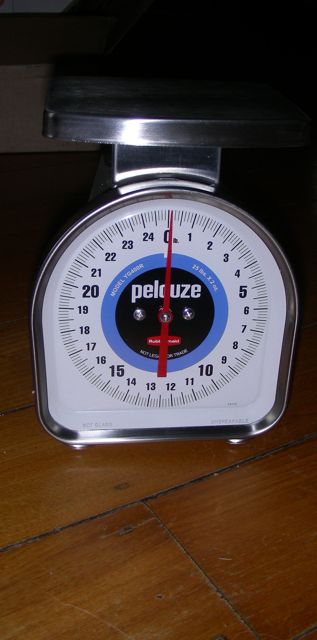
Since I think I've beaten the metric topic to death by now I'll say a little about our mid-range scale. Mostly good for all the stuff that isn't itty-bitty, like seeds, and isn't huge, like corn stalks, compost, and luggage. The mid-range scale, then, is actually very helpful in day-to-day harvesting, and we were really missing it last season, especially (as noted in the aforementioned potato post) when weighing potatoes out 1 lb 5 oz at a time. This one is bland, but high enough quality to be reliable. As you can see, the brand is Pelouze, which seems to be owned by Rubbermaid, for what that's worth. It was about $60 with shipping and all.

And for the grand finale, our new (very old) Fairbanks scale. At the Golden Rule garden I got hooked on huge platform scales that weigh a ton, both figuratively (because they're mostly cast-iron) and literally (since some of them have a 2000 lb capacity). Neat, huh? Apparently they are frequently found at farm auctions, where you can buy them for $5 and up. I wasn't in the know on that point till the past few weeks, and the $60 one posted on Craigslist was pretty enticing. Especially because all the other ones on Craigslist were $100-300. The greatest things about this kind of scale are that 1) they are virtually indestructible, 2) they have a large surface (~18"x 24") upon which to pile that which you wish to weigh, and 3) they can weigh incredibly heavy loads very accurately. You really can't beat that combo.

The scale is based on the design of Thadeus Fairbanks, who patented it waaaay back in 1830. They have a great history written up on the company's website. Ours dates back to the early 1900's. I'm sure it has seen a long, dull life, and we can't promise it much excitement, but we'll at least keep it indoors where it won't rust more than it already has.

My photos don't do it justice, but they give a good impression of the beast. At left is the full body shot, featuring cast-iron frame and wheels, wooden pillar and, gallows? I don't know what you'd call that thing. Below is a photo of the "user interface", which is brass. It goes up to 50 lb, then you can add extra weights (those disks off left) to the dangling fixture (on the right) to increase to capacity. We talked a little about going digital, but figured it was much better to steer clear of the electronics. They may be faster and easier not to botch up, but they also have shorter lives (I doubt any of the digital stuff I'm using now will still function in 20 years, let alone 100). So we've got it made! At least until we need to weight something under .05 grams or over 600 pounds...
3125

Wednesday, February 9, 2011

OOOOOOOOOOOOUCH!

That's the sound of the Dan working on the Kidney Stone.
Since not everyone comes from a medical family I will spare you the most vivid and fascinating details, which are available by request.
Skipping to the exciting part, at about 6 o'clock Tuesday morning I began having pain in my back below my ribcage. It rapidly got to the point where I asked Margo to call 911. That alone is saying something, because I have a healthy (and sensible) fear of being in the business end of a hospital. The great crew of Trotwood Rescue arrived, packed me up, and hauled me into Good Samaritan, our closest hospital.
I was then promptly loaded up with IV fluids and pain meds, which allowed me to take a good, deep breath and be grateful. Mom was waiting for me when I got there, and she was able to hang out with me the whole time. I got a visit from our pastor, Paula, who was at the hospital to visit someone much sicker than me and just happened to hear that I was in, too.
By about 1 o'clock I was checked out and on my way home, where I proceeded to sleep a lot.
That is the general idea.

Folks say that passing a kidney stone is one of the most painful experiences that one can have, on the order of childbirth. I guess I'm glad I can say I have lived through it, then, and have all the more respect for Margo having gone through childbirth without any pain medication.

I am grateful for everyone who made it an easier time for me, from Margo and Alten to Mom, the paramedics, nurses, techs, Paula, and the doctor who oversaw my case.

I feel like I am in a club, now. And now that I've done it, I'd like to cross "kidney stone" off my list and not have another one.
2990

Wednesday, February 2, 2011

Ice Storm!

When talk began Sunday about the possibility of an ice storm coming through this week, Margo and I got pretty excited. The odd mixture of below-freezing surface temperatures and slightly above-freezing precipitation, which coats everything exposed in an icy glaze, never seemed to happen in Willits while we were there. While they cause multitudes of wrecks, power outages, interruptions in commerce and the like, both Margo and I have always enjoyed them, and despite their destructive potential, no one who has taken a walk through the fields or woods after (or during) an ice storm can argue that they aren't beautiful events.

It started Monday night, and as I was heading home from Aikido on I-70 the windshield actually froze entirely over. That got me into the slow lane. Tuesday morning brought school closings and gratitude that none of us had anywhere to go for the day. On the half-mile walk to the garden to check our temperatures I found that the branches of honeysuckle, one of our many invasive shrubs, can be broken right off at the swing of a stick!

They were predicting up to a half-inch of ice accumulation, which seems incredible when you realize that every available surface will get coated, including roads, doors, steps, weeds, grass, littered trash, mops left out to dry, fences, power lines, and the dead limbs that have been waiting over those power lines for just such an occurrence... Which might explain the amazing green glow we each saw out different windows when the electricity was trying to decide whether to stay on or go back out last night. We only lost power for about an hour, which was long enough to be grateful for lots of candles, our new woodstove, and the foresight to have put a bunch of water aside for drinking water and toilet flushing.

As I walked around yesterday afternoon to take photos there was nearly a quarter-inch already.Today it has gotten worse from the additional fall of rain overnight, and now many businesses have decided that the school districts knew what they were talking about.

Here are some of the pictures I took... At top are weeds completely coated in ice, including their seedheads (which has something to do with how popular our bird feeders are right now). Next, one such bird feeder with a nuthatch on it. It has been entertaining watching the bigger birds, like grackles, sliding off the sides. Third, the chicken-wire roof of our hen-house run, sagging appreciably. Below are our clothesline, out of commission, and branches of a sugar maple with next season's buds encased.The weather forecast shows temperatures staying below freezing till at least Saturday, so I guess this will all stick around for a while...
2835